
Call: 505-219-4548
The Science Behind Safe Teeth Whitening for Sensitive Smiles for Albuquerque Residents
April 29, 2026
Uncategorized
You finally want a brighter smile, but every time you think about whitening, one question stops you cold: “Will it hurt?” If you have sensitive teeth, that concern is completely valid. A little zing from cold water or a sip of hot coffee is already enough to ruin your morning. The last thing you want is to sit through a whitening treatment that leaves your teeth aching for days.
Here is what you may not have heard yet: sensitivity and a brighter smile are not mutually exclusive. When the whitening process is approached with care, with the right concentrations, the right protective agents, and professional oversight, many people with sensitive teeth can achieve real, lasting results without significant discomfort.
If you are looking for safe teeth whitening in Albuquerque, you are not alone. Plenty of residents across the city and surrounding areas share the same goal: a visibly whiter smile without the pain. At Uptown Dental Associates, Dr. Greaves and the team are committed to making that a reality for you. This blog breaks down exactly how whitening works, what causes sensitivity during the process, and what steps professionals take to keep your experience as comfortable as possible.
Why Teeth Become Sensitive in the First Place
To understand whitening and sensitivity, it helps to understand your tooth structure. Each tooth is made up of several layers. The outermost layer, enamel, is the hard, mineralized shell that protects everything underneath. Just beneath it sits dentin, a porous tissue filled with microscopic tubules that connect directly to the nerve inside the tooth.
When enamel wears thin, when gums recede, or when these tubules become exposed, fluid movement inside them triggers nerve signals, and that is what you feel as sensitivity. Cold drinks, hot beverages, sweet foods, even a blast of air can set it off.
For people with naturally thin enamel or gum recession, those tubules sit closer to the surface. This makes them more reactive and requires a more careful approach during any whitening procedure.
How the Whitening Process Actually Works
Most professional whitening treatments use one of two active agents: hydrogen peroxide or carbamide peroxide. Both work by releasing oxygen radicals that penetrate the enamel and break apart the molecular chains of organic stain compounds trapped inside the tooth structure. This oxidation process targets intrinsic stains, the deep discoloration that sits beneath the surface, and lifts them from the inside out.
Hydrogen peroxide acts quickly. It releases its whitening effect within 30 to 60 minutes, which is why it is most often used in in-office treatments. Carbamide peroxide breaks down more slowly, releasing hydrogen peroxide over several hours. Because it works more gradually, it tends to be gentler and is commonly used in custom take-home tray systems.
The key point for sensitive patients: the concentration of the whitening agent matters enormously. Higher concentrations produce faster results, but they also increase the chance of temporary sensitivity. At lower, clinically appropriate concentrations, carefully chosen by your dentist based on your specific situation, the process becomes far more manageable.
Why Sensitivity Happens During Whitening and Why It Is Temporary
When peroxide molecules travel through the enamel and reach the dentin, they can trigger a temporary inflammatory response in the pulp. This is what produces the short-term sensitivity some people notice during or right after a whitening session, often described as brief, sharp sensations or “zingers.”
Crucially, this response is temporary. The peroxide does not permanently alter your nerve tissue or cause lasting damage to healthy teeth when used correctly. For most patients, any heightened sensitivity resolves within 24 to 48 hours after treatment. The goal of professional oversight is to minimize this window and reduce its intensity.
What Makes Professional Whitening Safer for Sensitive Smiles
This is where professional care makes all the difference. Over-the-counter strips and kits are one-size-fits-all products. They cannot account for the specific condition of your enamel, the degree of your sensitivity, or the unique geometry of your bite. Professional whitening, whether done in-office or through a dentist-supervised take-home system, is built around your individual needs.
Lower, Controlled Peroxide Concentrations
A dentist can prescribe or apply whitening gels at concentrations specifically calibrated for sensitive patients. This may mean using a lower-strength carbamide peroxide gel in custom trays over a longer treatment window, rather than a high-concentration hydrogen peroxide treatment in a single session. The result is still meaningful brightening, with significantly less irritation.
Desensitizing Agents Before and After Treatment
One of the most important tools in a dentist’s approach to sensitive-patient whitening is the use of desensitizing agents. Potassium nitrate is a widely studied compound that works by blocking the nerve signaling pathway within dentin tubules. When applied before a whitening session, either via desensitizing toothpaste, a pre-treatment gel, or a custom tray, it reduces how strongly the nerve responds to the peroxide.
Fluoride varnishes and fluoride gels are also applied after whitening to help occlude the open dentin tubules, slow fluid movement, and restore mineral strength to the enamel surface. Using potassium nitrate and fluoride together provides sensitive patients with a stronger protective buffer throughout the whitening process.
Gum Protection
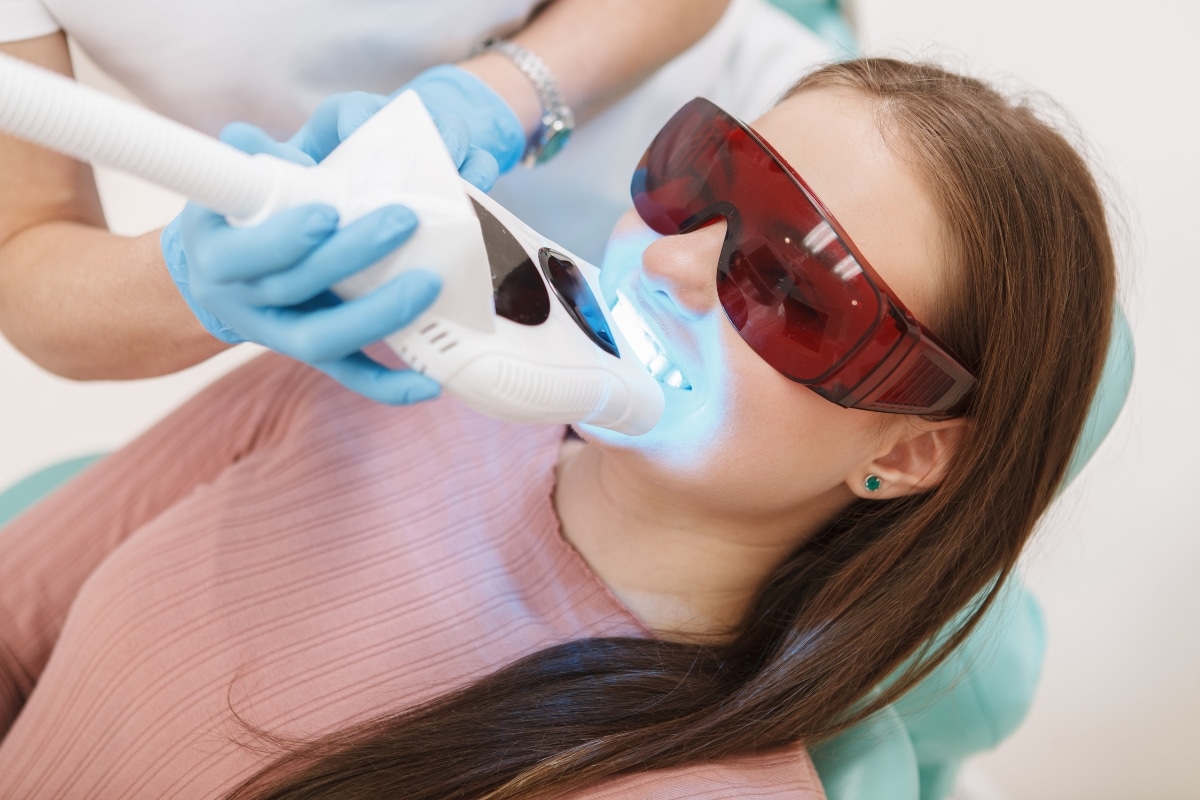
Gum tissue is far more vulnerable to peroxide irritation than tooth enamel. During in-office whitening, a protective barrier, typically a light-cured resin dam, is placed along the gumline before the gel is applied. This shields the soft tissue from contact with the whitening agent, which significantly reduces the risk of gum sensitivity and irritation.
Custom-Fitted Trays
Store-bought whitening trays are generic shapes that rarely fit precisely. Poorly fitting trays allow gel to seep onto the gums, irritating them. Custom trays, made from a mold of your actual teeth, fit flush against each tooth surface and keep the gel exactly where it needs to be and away from the tissue around your teeth.
A Note on Over-the-Counter Products
It is tempting to reach for whitening strips or toothpastes from the drugstore shelf, especially when they advertise “sensitive” formulas. While some of these products are gentler than standard versions, they carry important limitations. Many whitening toothpastes rely on abrasive particles to scrub surface stains. For people with thin enamel or already exposed dentin, this abrasion can worsen sensitivity over time rather than alleviate it.
If you have a history of tooth sensitivity, it is worth speaking to a dentist before starting any whitening routine, even an over-the-counter one. A professional can help you identify which approach is appropriate for your enamel condition and overall oral health.
How Dr. Greaves Approaches Whitening for Sensitive Patients
At Uptown Dental Associates in Albuquerque, Dr. Greaves takes a thorough, individualized approach with every patient before recommending any cosmetic treatment. For patients with sensitive teeth, the process starts with an oral health evaluation. This helps identify the root cause of sensitivity, whether it is enamel erosion, gum recession, exposed dentin, or an underlying issue that needs to be addressed first.
From there, the whitening plan is built around your specific situation. That might mean a lower-concentration take-home gel with custom trays and a pre-treatment desensitizing protocol. Or it might mean an in-office session with gum barriers, controlled gel application, and post-treatment fluoride to minimize recovery time. The approach is always thoughtful, measured, and focused on your comfort as well as your results.
Ready to find out if whitening is right for your smile?
Call Uptown Dental Associates at or visit to schedule a consultation with Dr. Greaves.
What to Do Before and After Your Whitening Session
Whether you have sensitive teeth or not, a little preparation goes a long way. Here are steps your dental team may recommend:
• Start using a desensitizing toothpaste containing potassium nitrate two weeks before your whitening session and continue for at least two weeks after.
• Avoid highly acidic foods and beverages like citrus, soda, and vinegar-based foods in the days leading up to and following treatment.
• Do not whiten on consecutive days. Space your sessions to give your teeth time to recover and remineralize.
• Let your dentist know immediately if sensitivity feels severe or lasts longer than 48 hours so they can adjust your plan.
• Follow post-treatment fluoride protocols exactly as recommended to close dentin tubules and strengthen enamel as quickly as possible.
You do not have to choose between a brighter smile and comfortable teeth. If you have been putting off treatment because of sensitivity concerns, visiting our dental office is the right first step. Our team serves patients from Albuquerque, Rio Rancho, Corrales, Edgewood, and surrounding communities in the greater Albuquerque area. We are here to answer your questions, walk you through your options, and create a plan that works for your smile and your comfort level.
Final Thoughts
Sensitive teeth do not have to stand between you and a brighter smile. When the whitening process is guided by a dental professional who understands your enamel, your sensitivity triggers, and your goals, it becomes a manageable and very effective treatment. The science is clear: with the right agents, the right concentrations, and the right protective steps, smile brightening can be done safely and comfortably, even for patients who have struggled with sensitivity their whole lives.
If you live in Albuquerque or the surrounding area and you are ready to take the next step, reach out to Uptown Dental Associates today. Book an appointment with Dr. Greaves and start the conversation about what a safer, more comfortable whitening experience could look like for you. Your brighter smile is closer than you think.
Book an appointment with Uptown Dental Associates today.
Call us at 505-219-4548 | 7101 Prospect Pl NE, Albuquerque, NM 87110 | uptowndentalassociates.com
Frequently Asked Questions
Q1. Is teeth whitening safe if I already have sensitive teeth?
Yes, when performed under professional guidance, whitening can be done safely even for sensitive patients. A dentist will evaluate your enamel condition and tailor the treatment concentration and desensitizing protocol to reduce discomfort throughout the process.
Q2. How long does sensitivity last after a whitening treatment?
For most patients, any sensitivity experienced after a whitening session is temporary and fades within 24 to 48 hours. Using a desensitizing toothpaste before and after treatment can significantly shorten this window.
Q3. What is the difference between hydrogen peroxide and carbamide peroxide for whitening?
Hydrogen peroxide works faster and releases most of its whitening power within 30 to 60 minutes, making it ideal for in-office treatments. Carbamide peroxide releases hydrogen peroxide more slowly over several hours and is generally gentler, making it a common choice for take-home trays for sensitive patients.
Q4. Can I use over-the-counter whitening products if I have sensitive teeth?
Some over-the-counter products are formulated for sensitive teeth, but they are not personalized to your specific oral health condition. Whitening toothpastes with abrasive particles can sometimes worsen sensitivity over time. It is worth consulting a dentist before starting any brightening routine.
Q5. What are desensitizing agents, and how do they help during whitening?
Desensitizing agents such as potassium nitrate and fluoride work by blocking nerve signals within dentin tubules that produce sensitivity. When applied before and after whitening, they significantly reduce the chance and intensity of post-treatment discomfort.
Q6. How many whitening sessions will I need?
The number of sessions depends on the degree of staining, the method used, and how your teeth respond. Your dentist will assess your starting shade and your sensitivity level to recommend a realistic treatment timeline. Some patients see satisfying results after one in-office session. In contrast, others benefit from a gradual take-home approach over several weeks.
Q7. Are there any conditions that would prevent me from getting whitening treatment?
Yes. Active cavities, gum disease, cracked teeth, or severely worn enamel need to be treated before any brightening procedure begins. A thorough dental evaluation will identify any of these issues so they can be addressed first, ensuring the whitening process is both safe and effective.
Recent Posts

Oct. 20, 2026
6 Popular Cosmetic Dentistry Procedures That Can Transform Your Smile

Oct. 12, 2026
Afraid of the Dentist? Here’s What Modern Practices Do Differently
Aug. 13, 2026
The One-Hour Fix Behind a Lot of Albuquerque’s Brightest Smiles
Aug. 05, 2026
What to Do in the First Hour of a Dental Emergency

Jul. 21, 2026